

Glass electrode
The glass membrane of FU20-05-T1-NPT responds to hydrogen-ion activity in the liquid and forms the pH-sensitive half of the measuring circuit.
Welcome to Moore Automation Limited

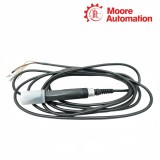

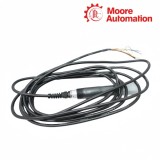

|
Copy and share this link on social network or send it to your friends
Copy| Product Name | Yokogawa FU20-05-T1-NPT pH/ORP Sensor |
| Item NO. | 2945393 |
| Weight | 0.1 kg = 0.2205 lb = 3.5274 oz |
| Category | YOKOGAWA |
| Brand | YOKOGAWA |
| Creation Time | 2026-11-26 |
Combined pH, ORP and temperature sensing
Exact code: 5 m integral cable, Pt1000 element and 3/4 NPT process connection.
Yokogawa identifies FU20-05-T1-NPT as a combined pH/ORP sensor in the FU20 liquid-analysis family. Its glass measuring electrode, platinum ORP electrode, double-junction reference system and Pt1000 temperature element place three related measurement paths in one body, while the integral cable carries those signals to the connected analyser.
Inside FU20-05-T1-NPT, the pH and ORP electrodes share the process contact but retain separate electrical functions. The Pt1000 element supplies the temperature value used by the analyser for pH compensation; it is not a process-temperature control output.
The body of FU20-05-T1-NPT provides two 3/4 NPT mounting positions and a 5 m cable. Installation keeps the wetted end below the horizontal by at least 15 degrees so air cannot collect around the glass electrode, while the cable entry remains protected from water ingress and mechanical strain.
| Technical Item | FU20-05-T1-NPT |
|---|---|
| Brand | Yokogawa |
| Product Type | Combined pH/ORP sensor |
| Brand Country | Japan |
| pH Measuring Range | pH 2 to 12 |
| ORP Measuring Range | -1500 to +1500 mV |
| Process Temperature | -10 to +105 °C |
| Process Pressure | 0 to 1 MPa |
| Minimum Conductivity | 50 µS/cm |
| Flow Velocity | 0 to 2 m/s |
| Temperature Element | Pt1000 |
| Reference System | Double junction, non-refillable KCl |
| Cable Length | 5 m |
| Process Connection | 3/4 NPT |
The three internal paths serve different parts of the analyser calculation and should not be treated as one interchangeable signal.
The glass membrane of FU20-05-T1-NPT responds to hydrogen-ion activity in the liquid and forms the pH-sensitive half of the measuring circuit.
The double PTFE junction connects the internal reference system to the process while limiting direct contamination of the internal electrolyte path.
The platinum surface provides the oxidation-reduction potential signal independently of the pH glass response.
The resistance element reports process temperature to the analyser so the pH channel can apply temperature compensation.
Orientation, thread engagement and cable routing define whether the sensor surfaces remain wetted and the signal path stays intact.
FU20-05-T1-NPT is installed vertically or at least 15 degrees below horizontal so bubbles do not remain inside the glass-electrode area.
The two tapered mounting positions fit a 3/4 NPT female connection; over-tightening can damage the sensor body.
A bypass or removable section lets the complete sensor be withdrawn without forcing the cable or electrode body.
The integral 5 m lead is routed without twist, sharp bending or standing water at the cable outlet.
Match the full FU20-05-T1-NPT nameplate code with the 5 m cable and both 3/4 NPT mounting positions. FU20 versions with 10 m, 20 m or retractable arrangements are different order codes, so the family name alone is insufficient.
A horizontal or upward-facing FU20-05-T1-NPT can retain air around the internal glass-electrode area. Install its wetted end downward and at least 15 degrees below horizontal before recalibrating the pH channel.
The Pt1000 inside FU20-05-T1-NPT belongs to the analyser’s temperature-compensation path. It is not specified as an independent process-temperature control sensor.
Inspect the wetted tip of FU20-05-T1-NPT for coating and confirm that the process keeps it fully immersed. Fouling around the shared tip can slow the pH response and disturb ORP even though the two electrical signals remain separate.
Support the 5 m FU20-05-T1-NPT lead so its weight does not pull on the cable entry. Keep the lead clear of hot surfaces and sharp edges, and do not twist it while engaging the tapered thread.
Before fitting FU20-05-T1-NPT, compare process temperature, pressure, flow velocity and liquid conductivity with the permitted limits. The wetted materials must also be chemically compatible with the actual liquid.
Moore Automation Limited is an international supplier of industrial control and monitoring hardware. Its catalogue spans PLC, DCS, HMI, drive, sensor and machinery-protection families from established manufacturers.
The company serves overseas industrial enquiries with an extensive stock programme for both current components and difficult-to-source legacy parts.



Moore Automation Sales Team
Copyright © 2004–2026 www.mvme.cn. All rights reserved.
Disclaimer: Moore Automation Limited is an independent reseller and is not an authorized distributor or representative of the manufacturers featured on this website. Product names and trademarks belong to their respective owners.
No related record found