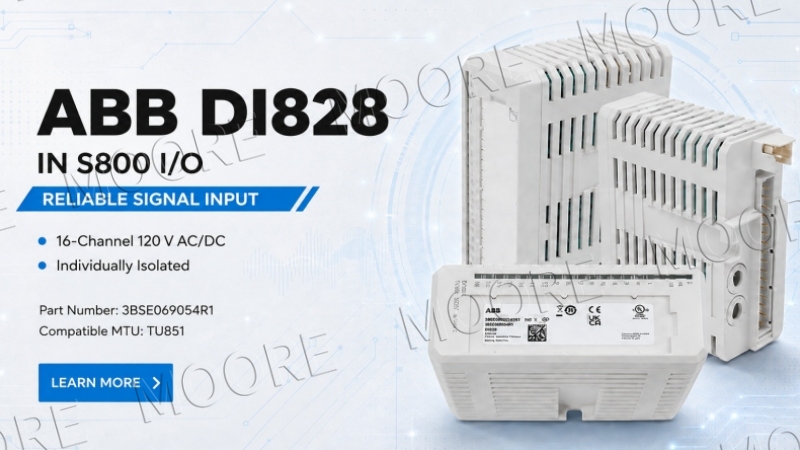
In industrial process control systems, digital input modules are responsible for converting the on/off states of field devices into digital signals that the controller can read and process. The ABB DI828 3BSE069054R1 is a 16-channel digital input module for the S800 I/O system, supporting 120 V AC and 120 V DC inputs. It can be used to acquire field signals such as relay contacts, limit switches, circuit breaker auxiliary contacts, and equipment operating and fault status.
The ABB S800 I/O is a comprehensive, distributed, and modular process I/O system that communicates with upper-level controllers via ModuleBus or industry-standard fieldbuses. The system allows I/O devices to be installed close to sensors and actuators, reducing field cabling distances and associated installation costs. The S800 I/O also offers hot-swappable modules, in-line reconfiguration, and redundancy options for some modules, providing flexible maintenance for continuous production processes. ABB S800 I/O Official Documentation
Connecting 120 V AC/DC Field Status Signals
The core function of the ABB DI828 is to connect 16 channels of 120 V AC/DC field signals to the S800 I/O system. The module uses current-sinking inputs with an AC input frequency range of 47–63 Hz, and can recognize the following voltage states:
Logic "0": 0–30 V AC or 0–20 V DC
Logic "1": 77–130 V AC or 75–130 V DC
120 V AC Input Current: 8.5 mA
120 V DC Input Current: 2.4 mA
Input Impedance: 14.2 kΩ AC or 50 kΩ DC
With its AC/DC compatible inputs, the DI828 can connect to field devices using different power supplies. The 16 input points are concentrated in one module, which also helps increase the signal access density within the control cabinet.
Single-Channel Isolation Improves Signal Reliability
Each of the DI828's 16 input channels uses an individual isolation structure. Each channel includes current-limiting components, EMC protection components, input status LEDs, optical isolation barriers, and analog filters.
Individual isolation limits the impact of electrical interference or abnormal conditions in one channel on other input channels. Optical isolation barriers establish electrical isolation between the field signal side and the internal circuitry of the S800 I/O, protecting the module and improving signal acquisition stability in complex industrial environments.
The DI828 has a rated insulation voltage of 250 V and a dielectric test voltage of 2000 V AC. The module complies with EN 61010, UL 61010, and relevant EMC standards, and is certified by ABS, BV, DNV, and LR marine classification, making it suitable for industrial and marine control projects that meet their environmental conditions and certification requirements. (ABB DI828 official product page)

Signal Filtering Reduces Input Status Misjudgments
Input cables in industrial environments may be affected by electromagnetic interference, contact jitter, or short-term voltage fluctuations. The DI828 features an analog filter in each input channel, with selectable digital filter times:
2.5 ±0.5 ms
5 ±1 ms
10 ±2 ms
20 ±4 ms
The analog filter's turn-on and turn-off delays are 5 ms and 10 ms, respectively. Configuring the digital filter time based on the speed of signal changes and interference immunity requirements can reduce the possibility of transient interference being mistakenly identified as valid state changes.
Note that the DI828 does not support SOE event sequence recording. Therefore, for projects requiring high-precision event timing, input modules supporting SOE functionality should be selected based on specific control requirements.
Channel Status Display Facilitates On-site Inspection
The DI828 front panel features Fault, Run, and Warning status LEDs, providing input status indicators for channels 1-16. Maintenance personnel can directly view the "0" or "1" status of each channel to quickly determine whether a field signal has arrived at the module.
Status LEDs can assist in checking field switch actions, wiring connections, and input voltages, but actual fault diagnosis still requires combining control system diagnostic information and field measurement results. The DI828's input status and diagnostic information are transmitted via the ModuleBus, enabling the upper-level control system to read the module's operating status and channel errors.
Voltage Monitoring Helps Identify Field Power Anomalies
Voltage monitoring is an important diagnostic function of the DI828 in the S800 I/O system. The module can use channel 1 as the voltage monitoring input for channels 2-8, and channel 16 as the voltage monitoring input for channels 9-15.
When voltage monitoring is enabled, if the monitoring voltage connected to channel 1 or channel 16 disappears, the relevant channel will generate a channel error, and the module's Warning LED will illuminate. Error signals can be read via the ModuleBus, helping the control system distinguish between field power loss and normal input status changes.
This group monitoring method is suitable for applications where multiple inputs share a field control power supply. When a group of devices loses power simultaneously, maintenance personnel can check the common power supply, protection devices, and wiring connections based on module warnings and channel error information, rather than checking whether each field device is simultaneously faulty.
Positioning in the Distributed S800 I/O Architecture
The DI828 is not a standalone controller, but rather a field signal acquisition module within the S800 I/O architecture. The module converts 16 channels of 120V AC/DC status signals into data that the S800 I/O system can process, and then transmits it to the upper-level process controller via the system communication interface.
S800 I/O allows the module to be installed close to field sensors and actuators, reducing the need for long-distance multi-core cables. The maximum field cable length for the DI828 is 200 m for AC input and 600 m for DC input, but the actual wiring distance must be determined based on cable capacitance, field interference, grounding method, and project specifications.
The DI828 uses the TU851 module terminal unit, with the corresponding keying code EB. The module is 45 mm wide, 119 mm high, and 102 mm deep, with a depth of 111 mm including the connector, and weighs approximately 0.15 kg. Proper matching of the MTU and keying structure helps avoid installing incompatible I/O modules.
Environmental Adaptability and Installation Considerations
The standard operating temperature range for the ABB DI828 is 0 to +55°C, with relevant certifications covering +5 to +55°C. The storage temperature range is -40 to +70°C, and the relative humidity is 5% to 95%, requiring no condensation. The module has an IP20 protection rating and is suitable for installation in control cabinets that meet protection and environmental requirements.
When using a compact MTU for vertical installation, the maximum ambient temperature is 40°C. Therefore, the control cabinet design must consider module orientation, internal temperature rise, ventilation conditions, and the heat dissipation impact of adjacent equipment. The typical power consumption of the DI828 is 3.5 W, with a typical +5 V ModuleBus current consumption of 45 mA and a maximum of 60 mA, and no +24 V ModuleBus current consumption.
The Practical Value of the DI828 in Process Control Systems
The primary value of the ABB DI828 3BSE069054R1 in S800 I/O systems lies in its stable acquisition of 16 channels of 120 V AC/DC field status signals. It enhances the reliability and diagnosability of signal access through independent channel isolation, input filtering, LED status indicators, and grouped voltage monitoring.
For power, process industry, manufacturing, and marine applications using 120 V control loops, the DI828 establishes a clear digital signal path between field devices and upper-level controllers. The voltage monitoring function also helps maintenance personnel identify common field power loss, reducing the possibility of misdiagnosing power supply problems as simultaneous failures of multiple devices.
Before selecting the DI828, the field signal voltage, AC/DC type, input logic, filtering requirements, MTU model, and installation environment should be confirmed. Since the DI828 itself does not support redundancy, SOE, HART, intrinsic safety, or high integrity features, projects requiring these features should select other S800 I/O modules that match the system design objectives.
FAQ
1. What is the function of the ABB DI828 3BSE069054R1 in the S800 I/O system?
The ABB DI828 3BSE069054R1 is responsible for acquiring 16 channels of 120 V AC/DC digital status signals and transmitting the input data and diagnostic information to the upper-level controller through the S800 I/O system.
2. What input voltages does the ABB DI828 3BSE069054R1 support?
The logic "1" input range of the ABB DI828 3BSE069054R1 is 77–130 V AC or 75–130 V DC, and the logic "0" range is 0–30 V AC or 0–20 V DC.
3. Why does the ABB DI828 3BSE069054R1 use a separate channel isolation?
The 16 input channels are individually isolated, reducing electrical interference between channels and enhancing protection between the field signal side and the module's internal circuitry.
4. How does the ABB DI828 3BSE069054R1 monitor field voltage?
Channel 1 can be used as the voltage monitoring input for channels 2-8, and channel 16 can be used as the voltage monitoring input for channels 9-15. When the monitored voltage disappears, the relevant channel will generate an error and illuminate the Warning LED.
5. Can the ABB DI828 3BSE069054R1 filter input signal interference?
Yes. The ABB DI828 3BSE069054R1 has analog filtering capabilities and offers four selectable digital filter times: 2.5, 5, 10, and 20 ms.
6. Which MTU should the ABB DI828 3BSE069054R1 be used with?
ABB official documentation specifies that the ABB DI828 3BSE069054R1 is used in conjunction with the TU851 module terminal unit, and the module keying code is EB.
7. Does the ABB DI828 3BSE069054R1 support redundancy or SOE functions?
The ABB DI828 3BSE069054R1 does not support module redundancy or SOE event sequence recording, nor does it support HART, intrinsically safe, or high integrity functions.
8. What precautions should be taken when installing the ABB DI828 3BSE069054R1?
Before installation, verify the 120 V AC/DC signal type, TU851 terminal unit, field cable length, and control cabinet temperature. The ABB DI828 3BSE069054R1 operates from 0 to +55°C. When using a compact MTU for vertical installation, the maximum ambient temperature is 40°C.
Contact Us
Manager: Leonia