Introduction
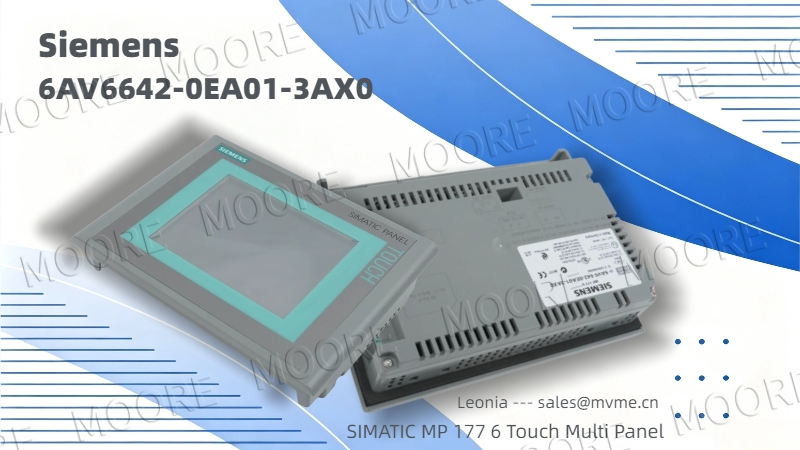
The Siemens SIMATIC MP177 6AV6642-0EA01-3AX0 multi-function touch panel, a classic human-machine interface (HMI) product from its early years, was officially discontinued on October 1, 2014. However, many existing production lines still use this model. In numerous industrial scenarios such as automotive manufacturing, logistics, water treatment, and general machinery, the MP177 touch panel performs core operational functions such as equipment data monitoring, parameter management, and alarm information display. As the equipment's service life increases, problems such as component aging, touchscreen malfunctions, and screen failures frequently occur. The availability of brand-new original equipment manufacturer (OEM) parts is tightening, and many factories face the risk of production line downtime. This article, based on the product's complete technical specifications, outlines the pain points of this HMI application, alternative solutions, and key points for spare parts procurement, providing a reliable reference for automation maintenance engineers and equipment procurement personnel. For purchasing, price inquiries, or to obtain alternative solution documents, please contact Manager Leonia at sales@mvme.cn or WhatsApp at +8618030175807.
I. SIMATIC MP177 Product Development History and Discontinuation Background
The SIMATIC MP177 6AV6642-0EA01-3AX0 was a 5.7-inch TFT touch multifunction panel from Siemens, running Windows CE 5. It was a core model in Siemens' classic second-generation mobile panel/operator panel product line. According to Siemens' official announcement, this product officially ceased delivery on October 1, 2014. Information on product updates and replacements can be found under SIMATIC Update ID: 62977695.
After the product was discontinued, Siemens no longer manufactured new original equipment units, only providing limited-term repair services. Over the years, the official repair channel has seen longer service cycles and continuously rising costs. Many aging production lines using this HMI cannot be fully upgraded in one go, and directly replacing the entire control system is extremely costly. Therefore, used original units and refurbished test parts have become the mainstream choice for emergency maintenance in factories. This model supports WinCC Flexible 2008 Compact and later versions for configuration, is compatible with a large number of new and old Siemens PLCs, and supports communication with multiple third-party controllers. This is a key reason why it still has a large market demand more than a decade later.
II. Hardware Structure and Core Advantages of Human-Machine Interaction
The SIMATIC MP177 is equipped with a 5.7-inch color TFT display with a resolution of 320×240 pixels and supports 65,536 colors. It uses an analog resistive touchscreen with no physical function buttons, relying on a built-in virtual keyboard for inputting numbers, letters, and hexadecimal parameters. The backlight module has a mean time between failures (MTBF) of 50,000 hours (at 25°C), meeting the needs of long-term uninterrupted operation in industrial settings.
The unit features a vertical installation design with an IP65 front-end protection rating, meeting the dust and water protection requirements for control cabinet panel installation. The rear interface area has an IP20 protection rating. Hardware-wise, it is equipped with a 32-bit RISC 520MHz processor, 2MB of user data storage, a maximum of 128MB of main memory, and an integrated hardware clock that can be retained even after power failure. The panel includes multiple communication interfaces: RS422, RS485, RJ45 Ethernet, and USB, allowing connection to external peripherals such as barcode scanners, mice, and printers.
Functionally, it natively supports alarm information systems, process recipe management, and process value upper and lower limit monitoring. A single project can support up to 100 recipes, with each recipe capable of recording 200 data records, making it suitable for food machinery, packaging equipment, rubber and plastics machinery, and other applications requiring batch process parameter switching.

III. Rich Communication Protocols, Compatible with Multiple Industrial Controller Brands
The MP177 is a highly compatible universal HMI, with communication capabilities being its core highlight. It not only fully adapts to the entire Siemens PLC series but also supports numerous third-party industrial control brands.
Siemens protocols supported include MPI, PROFIBUS-DP, PROFINET IO, and TCP/IP; third-party protocols include Modbus RTU and EtherNet/IP. It can interface with the full range of Siemens controllers, including S5, S7-200/300/400, S7-1200, and S7-1500, while also supporting PLCs from Mitsubishi, Omron, AB Rockwell, GE, Modicon, and other brands.
This diverse communication capability makes this HMI a top choice for many production lines with early hybrid control systems. Even if a production line uses controllers from multiple brands, centralized monitoring can be achieved through a single MP177, reducing early project networking costs. Even today, many retrofit projects are reluctant to replace their HMIs because reconfiguring and debugging communication programs would consume a significant amount of time.
IV. Industrial Environmental Adaptability and Industry Application Scenarios
The SIMATIC MP177 has undergone rigorous industrial certifications, possessing CE, GL marine classification, and FM Class I Div.2 explosion-proof zone certification, making it suitable for most general industrial environments. The normal operating temperature range is 0℃~50℃, the storage and transportation temperature range is -20℃~60℃, and the maximum relative humidity is 90%, with no condensation.
Typical application scenarios: automated packaging production lines, rubber and plastic extrusion equipment, water treatment control systems, port light conveying equipment, small machine tools, pharmaceutical auxiliary equipment, and warehousing and logistics machinery. Its FM explosion-proof certification allows it to be used in some Class II zone lightly hazardous conditions.
Note that this model does not support ATEX Zone 2 and Zone 22 explosion-proof standards. Careful evaluation is required for selection in high-risk dust and flammable/explosive gas scenarios.
V. Maintenance Solution Selection for Discontinued Equipment: Spare Parts Procurement and Product Replacement
Equipment has been discontinued for many years. Currently, there are three main maintenance solutions for the factory:
Solution 1: Procuring original salvaged/fully tested refurbished spare parts for direct replacement of faulty equipment. The advantage is that no program modification or re-tuning is required, resulting in the shortest downtime, suitable for emergency repairs.
Solution 2: Selecting a Siemens official successor HMI model for complete project program migration. This offers stronger long-term stability, but requires evaluation of the project configuration software version, communication line modifications, and opening size compatibility.
Solution 3: Repairing existing faulty panels. This is suitable for minor screen damage, power failures, and other simple issues. For serious faults such as motherboard aging or communication chip damage, the repair success rate is lower, and the warranty period is shorter.
When selecting and procuring, be sure to confirm the order number 6AV6642-0EA01-3AX0 to distinguish between different configurations of the MP177 model within the same series. Avoid inconsistencies in interface and memory configurations that could cause the original program to malfunction. It is recommended to provide the original equipment program version before procurement to complete compatibility checks in advance.
VI. Technical Specifications
Basic Information
Display: 5.7-inch TFT color display, 320×240 resolution, 65536 colors
Touch Method: Analog resistive touchscreen, no physical buttons, built-in on-screen virtual keyboard
Processor: 32-bit RISC, 520MHz clock speed
Memory: 2MB user data storage, maximum main memory 128MB
Operating System: Windows CE Version 5
Interfaces and Communication
Interfaces: 1×RS422, 1×RS485, 1×RJ45 Ethernet, 1×USB
Supported Protocols: MPI, PROFIBUS, PROFINET IO, EtherNet/IP, Modbus, TCP/IP, Sm@rtServer
External Devices: USB printer, barcode reader; supports MMC/SD Memory Card
Physical Parameters and Protection
Installation Method: Vertical panel mounting in control cabinet
Front-end protection: IP65; Rear-end protection: IP20
Dimensions: Front width 212mm, height 156mm; Opening size 198mm×142mm, installation depth 45mm
Weight: Maximum 0.85kg
Operating temperature: 0~50℃; Storage and transportation temperature: -20~60℃
Software Functions
Configuration Software: WinCC Flexible 2008 Compact and higher
Variable Limit: 1000 variables per device
Recipe Management: Up to 100 recipes, 200 records per recipe
Alarm System: 32 alarm categories, supporting 2000 bit alarms and 2000 analog alarms
Online Language: Supports 5 languages at runtime; up to 32 languages built into the project
Conclusion
Siemens SIMATIC MP177 6AV6642-0EA01-3AX0 As a classic industrial HMI, although officially discontinued in 2014, it continues to serve on numerous aging automated production lines worldwide thanks to its excellent controller compatibility, stable hardware architecture, and comprehensive process functions. However, with the increasing aging of equipment, frequent malfunctions such as screen blackouts, touchscreen failures, and communication interruptions have led to a shortage of brand-new original parts, placing immense pressure on equipment maintenance.
For manufacturing companies that cannot immediately upgrade their entire production line, pre-stocking tested and qualified backup HMIs is the most effective way to avoid unplanned downtime. We have a long-term supply of power-tested SIMATIC MP177 series spare parts, and can provide hardware testing, compatibility technical consultation, and comparison of replacement solutions between new and old models. For inquiries, technical data requests, or alternative solution consultations, please contact Manager: Leonia; Email: sales@mvme.cn; Whatsapp: +8618030175807.
FAQ
Q1: What precautions should be taken when installing the MP177 panel?
A: The equipment is designed for vertical panel mounting. The control cabinet panel must be machined strictly according to the 198mm × 142mm opening dimensions. The front of the equipment has IP65 protection; the matching sealing ring must be installed during installation. The rear interface area has IP20 protection; the inside of the control cabinet needs to be dustproof and moisture-proof. The ambient temperature should not exceed the rated range of 0~50℃, and it should not be installed in direct sunlight.
Q2: Can the existing MP177 program be directly downloaded to the replacement HMI?
A: It is necessary to confirm that the target model supports WinCC Flexible 2008 projects. Some new simplified panels require project migration, screen layout and communication parameter adjustments, and cannot be directly downloaded. It is recommended to back up the project before migration.
Q3: What are the common faults when the touchscreen malfunctions?
A: First consider the aging of the resistive touch panel; secondly, check whether the panel power supply voltage is stable; damage to the motherboard touch driver circuit is also possible. A simple touch panel failure can be replaced separately; motherboard failure has a high repair cost, so it is recommended to replace it with a spare part.
Q4: How long is the warranty period for purchased spare parts?
A: All spare parts undergo full-function power-on testing before leaving the factory, and a standard warranty period is provided. A test report is included with each shipment. After receiving the goods, we can assist customers with communication testing, program download and debugging technical support.
Q5: Can this MP177 be directly connected to an S7-1500 PLC?
A: The hardware supports communication, but the Ethernet TCP/IP communication driver needs to be correctly configured. Pay attention to the compatibility of the configuration software version. Some earlier versions of WinCC Flexible require the installation of corresponding communication patches.