





AMS vibration measurement · CNSPEC cable termination
Emerson PR9268/617-100-CNSPEC Electrodynamic Velocity Sensor
Model Information
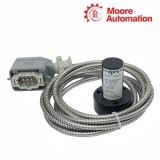
Emerson PR9268/617-100-CNSPEC is a vertical high-temperature electrodynamic velocity sensor in the AMS PR9268 family. It measures absolute case vibration by generating a velocity-proportional signal internally, so the measurement loop does not add a separate sensor excitation supply.
The PR9268/617-100-CNSPEC code defines the /61x vertical construction with the 10 m non-armored cable option and the CNSPEC open-end arrangement. Its resistor network is installed separately in the connection path, where wiring must preserve the intended 22.0 or 16.7 mV/(mm/s) tap and the corresponding amplifier load.
At the machine, PR9268/617-100-CNSPEC depends on the mounting face and vertical orientation to keep the seismic mass within its operating travel. At the receiving end, the open conductors, shield and separate resistor network must be documented before removal because the termination cannot be reconstructed from a Harting pin number.
Technical Specifications
| Brand | Emerson |
|---|---|
| Model | PR9268/617-100-CNSPEC |
| Product Name | Electrodynamic Velocity Sensor |
| Measurement | Absolute case vibration |
| Operating Orientation | Vertical high-temperature version |
| Frequency Range | 10 to 1000 Hz |
| Sensitivity Path 1 | 22.0 mV/(mm/s) with 100 kΩ load |
| Sensitivity Path 2 | 16.7 mV/(mm/s) with 50 kΩ load |
| Sensitivity Path 3 | 16.7 mV/(mm/s) with 20 kΩ load |
| Natural Frequency | 8 Hz ±1.5 Hz |
| Electrical Amplitude | 3000 µm peak-to-peak |
| Mechanical Amplitude | 4000 µm peak-to-peak |
| Cable | 10 m non-armored |
| Cable End | Open |
| CNSPEC Network | Separate resistor network |
| Sensor Resistance, Pin 3 Path | 3270 Ω ±10% |
| Sensor Resistance, Pin 1 Path | 3770 Ω ±10% |
| Inductance | ≤160 mH |
| Operating Temperature | -20 to 200°C |
| Degree of Protection | IP65 |
| Housing | Stainless steel |
| Approximate Weight | 1050 g |
CNSPEC Signal Network
The CNSPEC termination moves sensitivity selection from a molded connector into documented field wiring and a separate resistor network.
Each lead must be identified before disconnection because the cable end does not provide the fixed pin labels found on a Harting connector.
The resistor network belongs to the receiving side of the measurement chain. Its connections determine which coil tap and amplifier load create the selected sensitivity.
Cable shield and potential equalization follow the installation arrangement so interference is not added to the low-level velocity signal.
Mechanical Operating Conditions
The internal seismic system produces the signal only while mounting orientation, motion amplitude and temperature remain inside their documented limits.
The vertical design keeps the suspended mass in its operating position. Wider angular deviation requires the specified current condition rather than a software correction.
Electrical and mechanical amplitude limits protect the internal suspension from being driven beyond the intended measuring motion and prevent the moving system from striking its mechanical boundary.
The non-armored 10 m lead must be routed and strain-relieved so cable force does not reach the sensor body or disturb the open-end termination.
Common Product Questions
Why must PR9268/617-100-CNSPEC conductors be labeled before removal?+
What causes a PR9268/617-100-CNSPEC scaling error after reconnection?+
How should the PR9268/617-100-CNSPEC cable be routed?+
What mounting issue can affect PR9268/617-100-CNSPEC at low frequency?+
Can a Harting-connector PR9268 replace PR9268/617-100-CNSPEC directly?+
What should be included in a PR9268/617-100-CNSPEC request?+
Why Choose Moore Automation
Moore Automation
https://www.mvme.cn/Moore Automation handles industrial automation requests with emphasis on exact-model discipline. The commercial record can include the requested identity, quantity and supporting label details without substituting a nearby variant.


No related record found