

Velocity sensing
The sensing head responds to vibration of the machine casing at its mounting point. Its electrical response represents velocity rather than proximity gap or shaft displacement.
Welcome to Moore Automation Limited

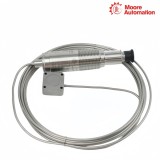
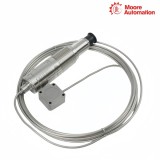
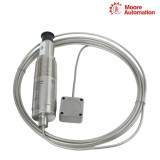

|
Copy and share this link on social network or send it to your friends
Copy| Product Name | Bently Nevada 330750-20-05 High Temperature Velomitor System |
| Item NO. | 2931709 |
| Weight | 0.1 kg = 0.2205 lb = 3.5274 oz |
| Category | BENTLY NEVADA |
| Brand | Bently Nevada |
| Creation Time | 2026-11-11 |
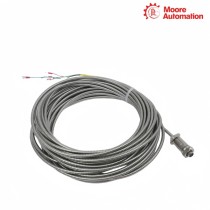
Bently Nevada 330750-20-05 is a High Temperature Velomitor system that converts machine-casing vibration velocity into an electrical output. The complete assembly combines a high-temperature sensing head, a 2 m integral cable and remote signal-conditioning electronics.
Temperature zoning defines how Bently Nevada 330750-20-05 is arranged: the sensor and integral cable operate at temperatures up to 400 °C, while the signal conditioner is limited to 121 °C. Separating these sections lets the sensing end remain on the hot machine surface while the electronics operate in the cooler location.
The conditioned output of Bently Nevada 330750-20-05 has a nominal sensitivity of 5.7 mV/mm/s. Its response is specified from 15 to 2000 Hz within ±3 dB, with a tighter ±0.9 dB band from 20 to 1000 Hz, linking casing velocity to the monitor input across the stated frequency range.

| Specification | 330750-20-05 |
|---|---|
| Brand | Bently Nevada |
| Product Name | High Temperature Velomitor System |
| Country | Not specified |
| Cable option | 2 m |
| Approval option | 05 — multiple approvals |
| Sensitivity | 5.7 mV/mm/s ±5% |
| Frequency response | 15–2000 Hz ±3 dB |
| Precision band | 20–1000 Hz ±0.9 dB |
| Sensor/cable limit | Up to 400 °C |
| Conditioner limit | Up to 121 °C |
| Measurement | Casing velocity |
| Construction | Remote signal conditioner architecture |
The sections of Bently Nevada 330750-20-05 divide sensing, signal transfer and conditioning into separate functions within one velocity-measurement system.
The sensing head responds to vibration of the machine casing at its mounting point. Its electrical response represents velocity rather than proximity gap or shaft displacement.
The 2 m integral cable carries the sensor response away from the hot mounting location. It is part of the high-temperature section and remains attached to the sensing assembly.
The remote electronics condition the sensor response into the specified velocity output. Locating this section away from the hottest surface keeps it within the 121 °C electronics limit.
The usable output of Bently Nevada 330750-20-05 is defined by sensitivity, frequency response and the temperature limit assigned to each physical section.
The 5.7 mV/mm/s sensitivity sets the relationship between casing velocity and output amplitude. Monitor scaling uses this relationship to interpret the conditioned signal.
The broad 15-2000 Hz range is specified within ±3 dB, while the 20-1000 Hz range carries the tighter ±0.9 dB tolerance. The two bands describe different accuracy limits rather than interchangeable values.
The 400 °C rating applies to the sensor and integral cable, not to the complete assembly. The signal conditioner retains its separate 121 °C limit.
Check whether the signal conditioner is above its 121 °C limit even when the sensor and cable remain within their 400 °C limit; the two temperature ratings apply to different sections. This boundary applies to Bently Nevada 330750-20-05.
On Bently Nevada 330750-20-05, verify that the complete record carries the `20` option for the 2 m integral cable and that the sensor-to-conditioner route fits within that fixed assembly length.
Bently Nevada 330750-20-05 requires this check: The sensing head measures casing velocity at its mounting point, so a different casing location has a different mechanical response even when the channel scaling remains unchanged.
For Bently Nevada 330750-20-05, confirm that the channel uses the 5.7 mV/mm/s sensitivity of the complete system and that no proximity-probe scale factor has been entered.
The correct approach for Bently Nevada 330750-20-05: Use the 15-2000 Hz ±3 dB band for the broad response and the 20-1000 Hz ±0.9 dB band when the tighter tolerance is required; do not treat the two limits as the same specification.
With Bently Nevada 330750-20-05, retain the `05` multiple-approval identity with the complete system and verify that the supplied approval record matches the site requirement.

Moore Automation works with legacy automation platforms whose original product lines may be mature, discontinued or difficult to identify from appearance alone.
The company organizes old label data, revision information and application notes before commercial review, helping customers preserve the installed-system context.


Moore Automation Sales Team
Copyright © 2004–2026 www.mvme.cn. All rights reserved.
Disclaimer: Moore Automation Limited is an independent reseller and is not an authorized distributor or representative of the manufacturers featured on this website. Product names and trademarks belong to their respective owners.
No related record found