

Selection boundary
Open-wire, shorted-input and wiring-error checks supervise field connections.
Welcome to Moore Automation Limited




|
Copy and share this link on social network or send it to your friends
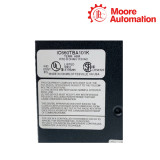
Copy| Product Name | GE Fanuc IC660BBA101 Genius RTD Input Block |
| Item NO. | 2902607 |
| Weight | 0.1 kg = 0.2205 lb = 3.5274 oz |
| Category | GE |
| Brand | GE |
| Creation Time | 2026-08-31 |
GE Fanuc 3 isolated pairs
Six-channel RTD input block for platinum, nickel and copper resistance temperature detectors.
IC660BBA101 is a Genius I/O RTD block with six input circuits arranged as three isolated pairs. It accepts platinum, nickel or copper RTDs and linearizes each circuit according to the selected sensor type.
Temperature or resistance values can be returned in tenths of degrees Celsius, tenths of degrees Fahrenheit, tenths of ohms or counts. Alarm thresholds, RTD resistance, alpha type, linearization and filter time are configurable per application.
The block is factory calibrated and includes open-wire, shorted-input, wiring-error, overrange, underrange and internal-fault diagnostics. The 115 VAC/125 VDC supply version is electrically different from the 24/48 VDC IC660BBA021 only at the block power supply.

Open-wire, shorted-input and wiring-error checks supervise field connections.
High and low alarms are configurable for each circuit.
Factory calibration removes routine field recalibration from the normal setup.

Six circuits are divided into three groups of two.
Open-wire, shorted-input and wiring-error checks supervise field connections.
Three isolated input pairs; each channel supports a configured RTD characteristic.
Inputs: 6 RTD-compatible; Grouping: 3 isolated pairs.
Each input is linearized for its configured RTD material and alpha type.
No model-specific replacement or lifecycle statement is used on this page; identify the exact article and system configuration instead of assuming equivalence.


Moore Automation Sales Team
Copyright © 2004–2026 www.mvme.cn. All rights reserved.
Disclaimer: Moore Automation Limited is an independent reseller and is not an authorized distributor or representative of the manufacturers featured on this website. Product names and trademarks belong to their respective owners.
No related record found