

Seventy-five-g range
The 25 mV/g scale allows the sensor to represent acceleration up to 75 g peak without using the higher-sensitivity 330400 range.
Welcome to Moore Automation Limited



|
Copy and share this link on social network or send it to your friends
Copy| Product Name | Bently Nevada 330425-01-00 | 25 mV/g High-Range Accelerometer |
| Item NO. | 2925767 |
| Weight | 0.1 kg = 0.2205 lb = 3.5274 oz |
| Category | BENTLY NEVADA |
| Brand | Bently Nevada |
| Creation Time | 2026-10-21 |
Bently Nevada · machinery-casing acceleration transducer
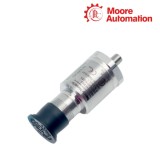
Bently Nevada 330425-01-00 is a case-mounted acceleration transducer for machinery-casing measurement where the 75 g peak range and 25 mV/g sensitivity are required. It converts axial casing acceleration into an electrical signal for the connected monitoring system.
The first suffix of Bently Nevada 330425-01-00 selects the 1/4-28 UNF integral mounting stud, while the final 00 selects no agency approval option. A three-pin MIL-C-5015 receptacle carries the powered sensor output, and the case remains electrically isolated.
When Bently Nevada 330425-01-00 is installed on a rigid bearing housing or machine casing, the mounting interface transfers casing motion into the sensing element. The receiving instrument supplies −24 Vdc with nominal 2 mA bias current and reads the −8.5 Vdc biased acceleration signal.
Bently Nevada 330425-01-00 trades sensitivity for a larger acceleration envelope while retaining a wide casing-vibration bandwidth.
The 25 mV/g scale allows the sensor to represent acceleration up to 75 g peak without using the higher-sensitivity 330400 range.
Casing motion is measured from 10 Hz to 15 kHz within ±3 dB, with a tighter ±10% band from 30 Hz to 10 kHz.
Transverse sensitivity remains below five percent of the axial response, keeping the sensitive axis dominant when the mounting face is correctly prepared.
Bently Nevada 330425-01-00 depends on a rigid, correctly torqued mounting path so machine-casing acceleration reaches the sensing element without interface distortion.
The 1/4-28 stud transfers casing motion into the body, while the three-pin receptacle connects the powered output to the monitoring input.
Machine or verify the mounting pad so the accelerometer seats squarely on the bearing housing or machine casing.
Thread the 1/4-28 stud into the prepared hole and tighten the sensor to the specified 4.1 N·m mounting torque.
Use the matching three-socket connector, strain-relieve the cable and preserve shield and conduit protection through the run to the monitor.
Bently Nevada 330425-01-00 intentionally uses 25 mV/g sensitivity to provide a 75 g peak range, whereas the 330400 is the 100 mV/g version. Confirm the monitor channel scale before interpreting the lower voltage as a sensor fault.
Bently Nevada 330425-01-00 requires −24 ±0.5 Vdc and nominal 2 mA bias current through the correct three-pin connection. Verify supply polarity, common and signal wiring before changing the vibration alarm configuration.
Bently Nevada 330425-01-00 transfers casing acceleration through its integral 1/4-28 stud. A rough, flexible or loose mounting surface changes the mechanical coupling, so use a flat rigid pad and the specified mounting procedure before judging the 10 Hz to 15 kHz response.
Bently Nevada 330425-01-00 uses a three-pin MIL-C-5015 receptacle with powered sensor output. The mating cable must preserve the specified supply, signal and return conductors plus shielding; a connector that merely fits does not guarantee the correct electrical path.
Bently Nevada 330425-01-00 is rated for 75 g peak. Confirm the monitor scaling and whether the actual transient exceeds that envelope; changing alarm values cannot restore signal information once the sensor or input range is exceeded.
Bently Nevada 330425-01-00 supports cable runs up to 305 m without stated signal degradation when the specified shielded connection is maintained. Keep the cable protected and preserve shield continuity rather than treating the maximum distance as independent of installation quality.
Moore Automation supports enquiries for obsolete, discontinued and difficult-to-source industrial components as well as current products. Legacy requests are handled by the complete part number rather than by a broad series name alone.
Suffixes, modification codes and installed-system notes are retained because older product families often contain mechanically or electrically different executions. Any alternative requires separate review instead of silent substitution.
Use the channels shown here for technical product and purchasing enquiries.


Moore Automation Sales Team
Copyright © 2004–2026 www.mvme.cn. All rights reserved.
Disclaimer: Moore Automation Limited is an independent reseller and is not an authorized distributor or representative of the manufacturers featured on this website. Product names and trademarks belong to their respective owners.
No related record found